Two years ago, a scroll through any fintech feed turned up a steady stream of Product Manager and CPO hires. Lately, that mix has flipped: most of what shows up is Business Development and Sales.
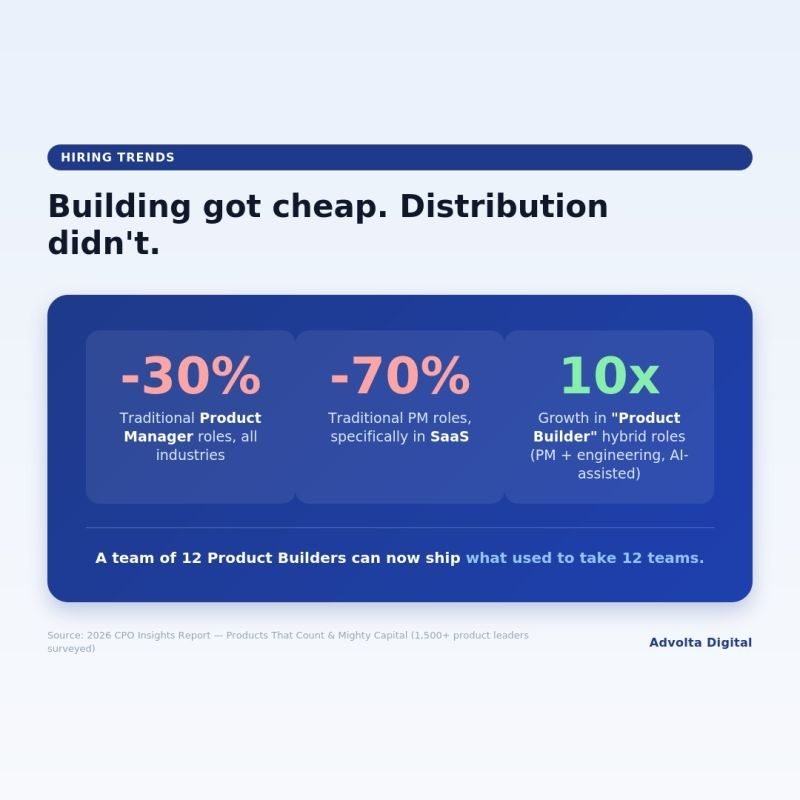
Part of this is measurable. A 2026 CPO Insights Report, based on a survey of 1,500+ product leaders, found that traditional Product Manager roles are down 30% across industries — and down as much as 70% within SaaS specifically. At the same time, "Product Builder" roles — hybrids that combine product thinking with hands-on, AI-assisted engineering — have grown 10x. The report's framing is blunt: a team of twelve Product Builders can now ship what used to take twelve full teams.
Building got cheap. Distribution didn't.
That's the part worth sitting with. If a single hybrid operator can take a product from idea to working version using AI tooling, the bottleneck in a company shifts. It's no longer "can we build this." It's "can we get this in front of the right people, on terms that convert."
That raises a genuine question for founders and hiring leaders in fintech and payments, where distribution has always depended on partnerships, licensing relationships and direct enterprise deals rather than pure product-led growth: does this shift mean founders will increasingly ship a first version themselves, using AI tools, and then hire specifically to sell it — regardless of whether the product was properly validated first? Or does the compressed cost of building simply raise the bar for what counts as validation before a product ever reaches a distribution hire?
Either way, the signal in the hiring data is hard to ignore. Teams that used to lead with product headcount are now leading with go-to-market headcount — and the product function is expected to be smaller, more technical, and more AI-fluent than it was even two years ago.