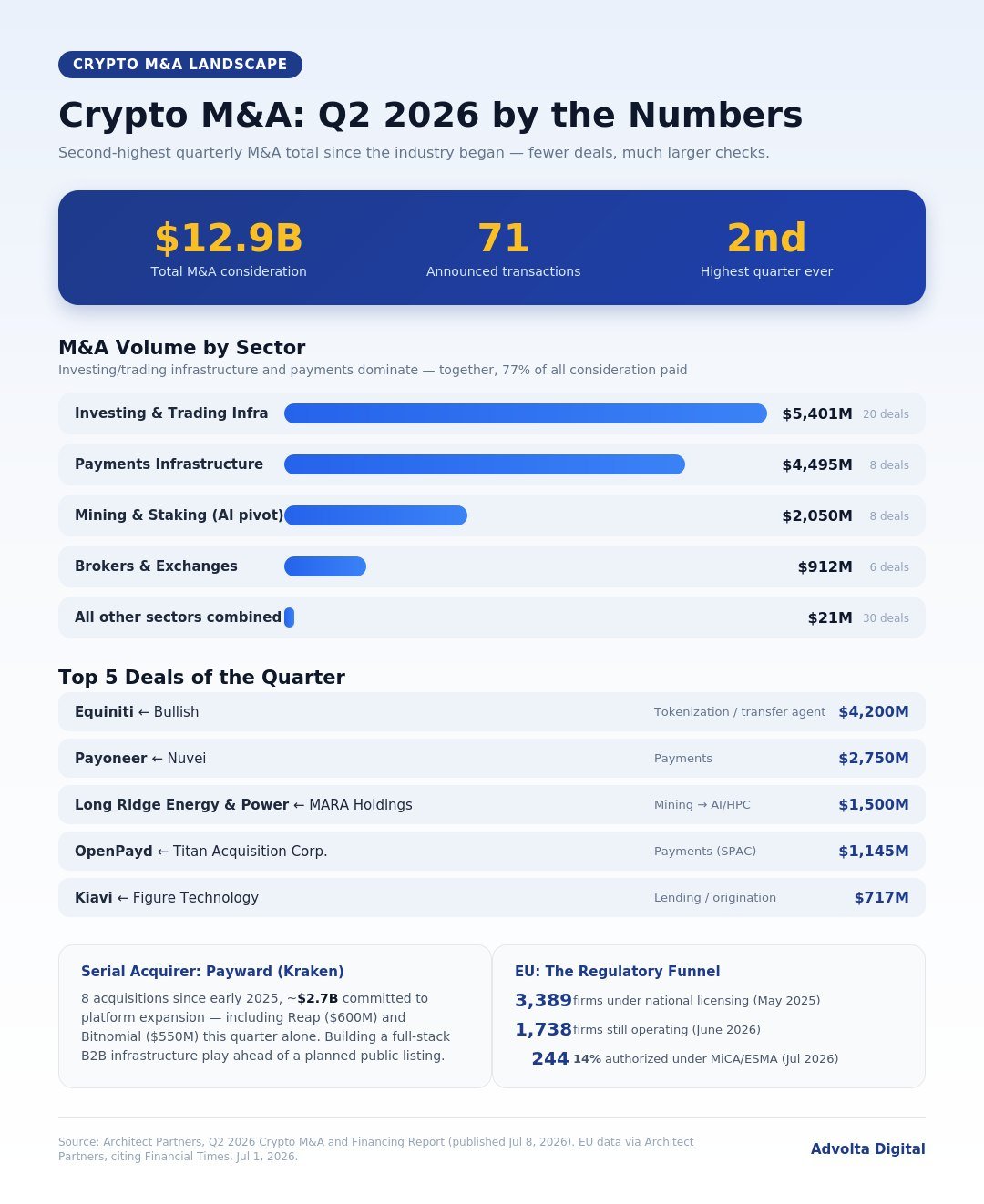
Crypto M&A just posted its second-highest quarter ever: $12.9 billion in consideration across 71 announced transactions in Q2 2026. The headline number hides the more interesting story. Deal count is down sharply while check sizes went up. The "easy" consolidation phase — lots of small, cheap acquisitions — is over. What's left is expensive.
Two sectors absorbed 77% of all consideration paid. Investing and trading infrastructure led at $5.4 billion across 20 deals, anchored by Bullish's $4.2 billion acquisition of transfer agent Equiniti. Payments infrastructure followed at $4.5 billion across just 8 deals, led by Nuvei's $2.75 billion purchase of Payoneer. Both deals share the same underlying logic: buying regulated infrastructure and existing licenses rather than building them from scratch.
The serial acquirer playbook
Payward, Kraken's parent company, is the clearest example of this playbook in motion — 8 acquisitions since early 2025, roughly $2.7 billion committed, two of them in this quarter alone (Reap at $600M, Bitnomial at $550M). This isn't diversification for its own sake. It's assembling a full-stack, regulated B2B platform ahead of a planned public listing.
Further down the list, the pattern holds: Long Ridge Energy & Power's $1.5 billion acquisition by MARA Holdings converts mining infrastructure into AI/HPC capacity, OpenPayd's $1.145 billion SPAC deal with Titan Acquisition Corp. consolidates payments rails, and Figure Technology's $717 million purchase of Kiavi adds lending origination to an existing platform. Almost none of this quarter's largest deals are about market share. Nearly all of them are about acquiring a capability or a license that would otherwise take years to build.
Of 3,389 firms operating under national licensing in the EU as of May 2025, only 244 — 14% — hold a MiCA authorization today.
That EU data point is the one worth sitting with. It's the regulatory funnel this consolidation wave is flowing through. M&A activity like this is exactly how that 14% figure eventually closes — not primarily through new entrants clearing the licensing bar themselves, but through acquisition of the firms that already have.
Consolidation isn't a side effect of tightening regulation anymore. At this point, for a lot of these buyers, it is the strategy.