For eight years, American retail investors couldn't legally buy a new crypto token at launch. Anyone who's worked on a token sale knows the line by heart: "not open to US persons." This week the SEC proposed changing that.
The story behind that line goes back to 2017, when crypto projects raised money by selling tokens directly to the public. The SEC's position was straightforward: that counts as selling securities, same as stock. The industry's workaround was a contract structure called a SAFT — it argued that the investment being sold today would turn into a plain product later, so securities rules shouldn't apply to that later stage. Courts didn't accept it. In 2020, the SEC sued Telegram and Kik over exactly this argument, and won. Telegram alone had to return $1.2 billion to investors.
What followed was less a fix than a workaround: projects relocated their entities to the BVI, Cayman, Seychelles, Panama, the Marshall Islands, Switzerland or Singapore — wherever tokens could be sold without US rules attached, always with the same disclaimer in the contract. FTX alone operated entities across more than 20 jurisdictions. This was rarely about avoiding tax. It was that the US offered no legal path to sell a token to its own citizens.
Two tracks, one exit ramp
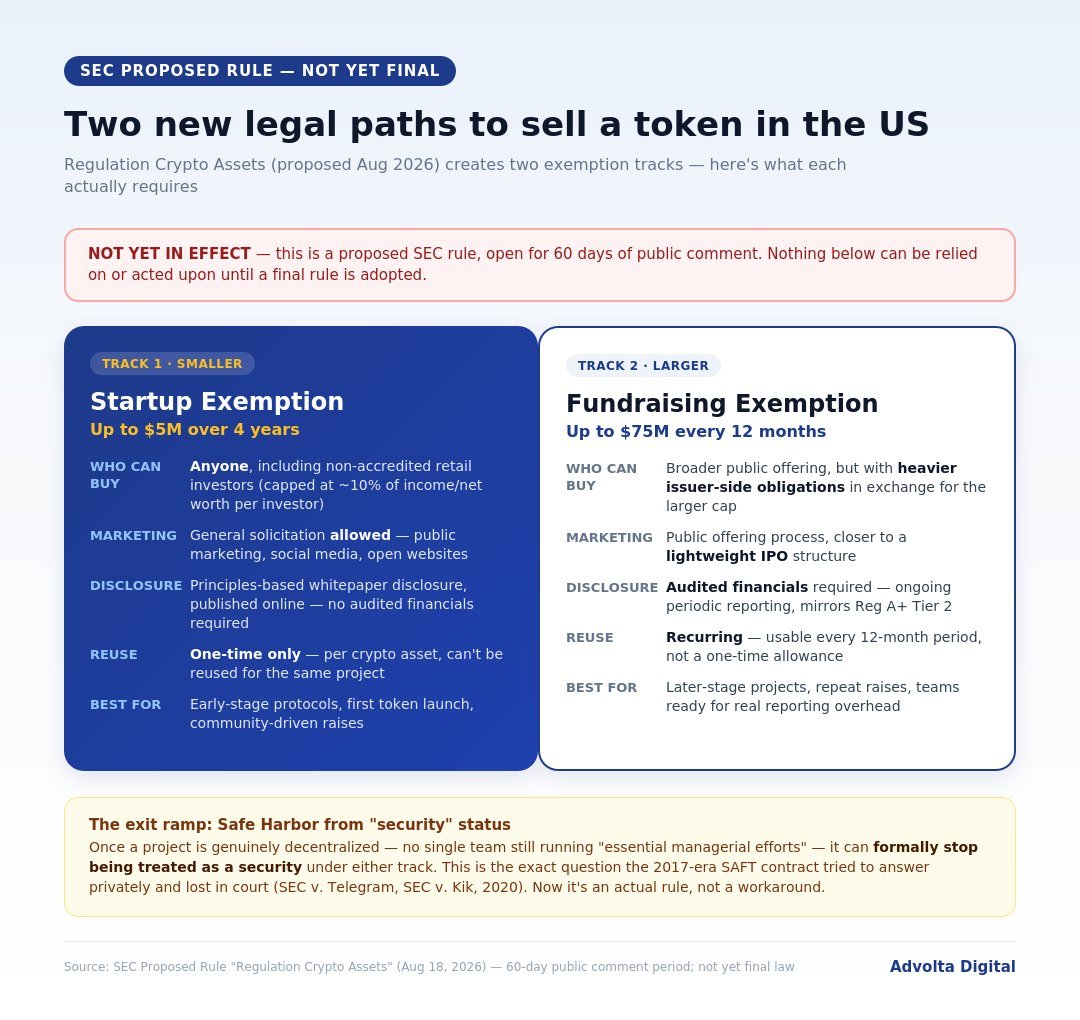
The SEC's new proposal, Regulation Crypto Assets, tries to solve this with an actual rule rather than another enforcement action. It creates two exemption tracks.
- Startup Exemption — up to $5M over 4 years, open to anyone including non-accredited retail investors (capped at roughly 10% of income or net worth per investor). General solicitation is allowed, and disclosure is principles-based: a published whitepaper, no audited financials required. It's a one-time allowance per crypto asset, best suited to early-stage protocols doing a first token launch.
- Fundraising Exemption — up to $75M every 12 months, structured closer to a lightweight IPO process, with audited financials and ongoing periodic reporting that mirrors Reg A+ Tier 2. Unlike the startup track, this allowance is recurring, usable every 12-month period — built for later-stage projects doing repeat raises with real reporting overhead.
Alongside both tracks sits a genuine exit ramp: once a project is authentically decentralized — no single team still running its "essential managerial efforts" — it can formally stop being treated as a security under either track. That's the exact question the 2017-era SAFT contract tried to answer privately and lost in court. This time it's a proposed rule, not a workaround.
Not yet in effect — this is a proposed SEC rule, open for 60 days of public comment. Nothing above can be relied on or acted upon until a final rule is adopted.
It's worth sitting with that caveat. Eight years of offshore entity structuring, disclaimer language and enforcement risk came from the simple absence of a legal onshore path — and that gap may be closing. But a proposal is not a rule. The next 60 days of public comment will shape what actually gets adopted, and nothing here changes a token sale's legal status until it does.